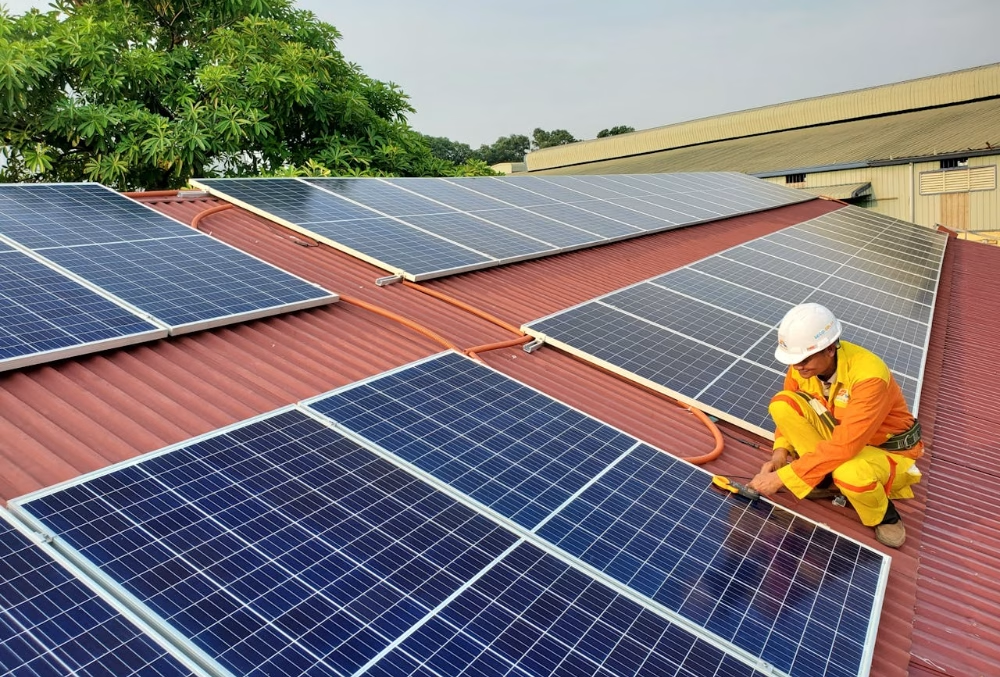
If you’ve ever stared at a silent, stationary slab of glass on your roof and wondered how it’s currently powering your fridge or juicing up your Tesla, you aren’t alone. It’s not “magic,” and it’s certainly not your roof just being decorative—it’s a high-stakes game of physics where sunlight gets hustled into becoming electricity.
For the modern property owner, understanding this energy conversion process is about more than just curiosity—it’s about knowing exactly how your solar panels turn the tropical sun into tangible financial breathing room.
Different Types of PV Panels
Not all solar panels are created equal; choosing the right “flavour” of photovoltaic (PV) technology is a bit like choosing between a tailored suit and an off-the-rack number—it all depends on how much “premium real estate” you have and how much you’re willing to spend. In Singapore, where roof space is often tighter than a rush-hour MRT, the efficiency of your chosen tech dictates exactly what kind of energy yield you can expect and how efficiently your system will convert sunlight into savings.
Monocrystalline Panels: The gold standard for efficiency, these are sliced from a single, pure silicon crystal. They offer the highest power output in the smallest footprint and sport a premium, uniform black look that blends seamlessly into modern architecture.
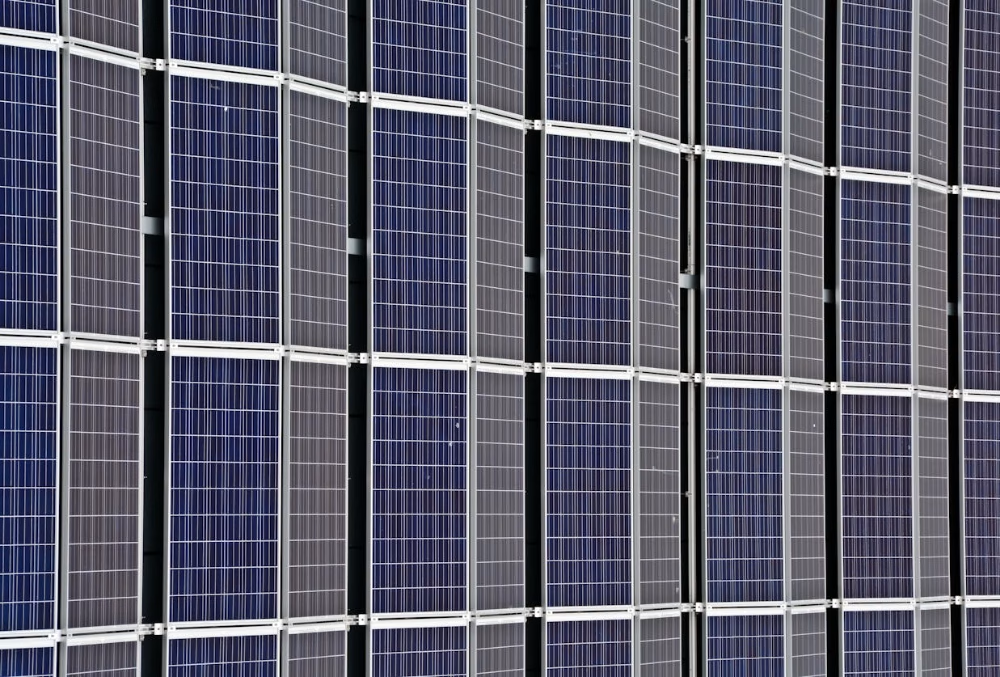
Polycrystalline Panels: Created by melting multiple silicon fragments together, these are the budget-friendly workhorses of the solar world. While they require a bit more surface area to match the output of their monocrystalline cousins, their distinct blue-speckled appearance is a common sight on larger industrial rooftops.
Thin-Film Panels: These lightweights are made by layering materials onto flexible surfaces, making them perfect for curved roofs or weirdly shaped commercial structures. Their efficiency is a bit lower, but their ability to go where rigid panels can’t makes them the go-to for unconventional roof-flexing.
What is the Energy Conversion in a Solar Panel?
To get a bit more technical, the conversion process is all about managing the “p-n junction”—the internal border between the positive and negative layers of a solar cell. This junction acts like a one-way street, ensuring that once those electrons are knocked loose by the sun, they can’t just drift back to where they came from. Instead, they’re channelled into a grid of conductive wires.
As the sunlight strikes, the semiconductor material (usually crystalline silicon) facilitates this transition of electrons from a low-energy state to a high-energy “excited” state. By forcing these electron-hole pairs to separate and travel through a circuit, the panel creates a reliable stream of power. It’s practically a high-speed highway of energy that only operates when the sun provides the “green light.”
So, how do these tiny cells work to power your entire building? Essentially, the sequence goes like this:
Silicon layers soak up photons (particles of light) from the sun.
These photons pass their energy to the electrons inside the silicon.
The electrons get “excited” and jump out of their usual spots, leaving behind a “hole.”
Because the cell has positive and negative layers, these free electrons are forced to move in a single direction.
This steady stream of moving electrons converts that energy into direct current (DC) electricity.
The Inverter: Your System’s Universal Translator
The electricity flowing straight off your roof is in the form of direct current (DC), but there’s a catch: your aircon, TV, and the Singapore power grid all speak the language of alternating current (AC). This is where the inverter, the “translator” of your system, comes in to save the day. It takes that raw, unrefined DC energy and flips it into the AC format used by your building, ensuring the power is safe, stable, and ready to work the moment you decide it’s time to blast the AC.
Stop Catching Heat, Start Catching Power
For years, your roof has done nothing but absorb the relentless Singaporean heat, making your aircon work harder and your bills climb higher. By understanding the science of conversion, you can see that solar isn’t just an addition to your building—it’s a fundamental upgrade that turns a passive liability into an active power plant.
At FOMO Energy, we make sure that every photon hitting your roof is put to work immediately. Whether we’re kitting out your family home with high-efficiency residential solar panels or deploying massive, sun-hungry arrays of commercial solar panels for your business, our goal is the same: to help you stop being a passive victim of your monthly utility bill and start being the one who actually calls the shots.