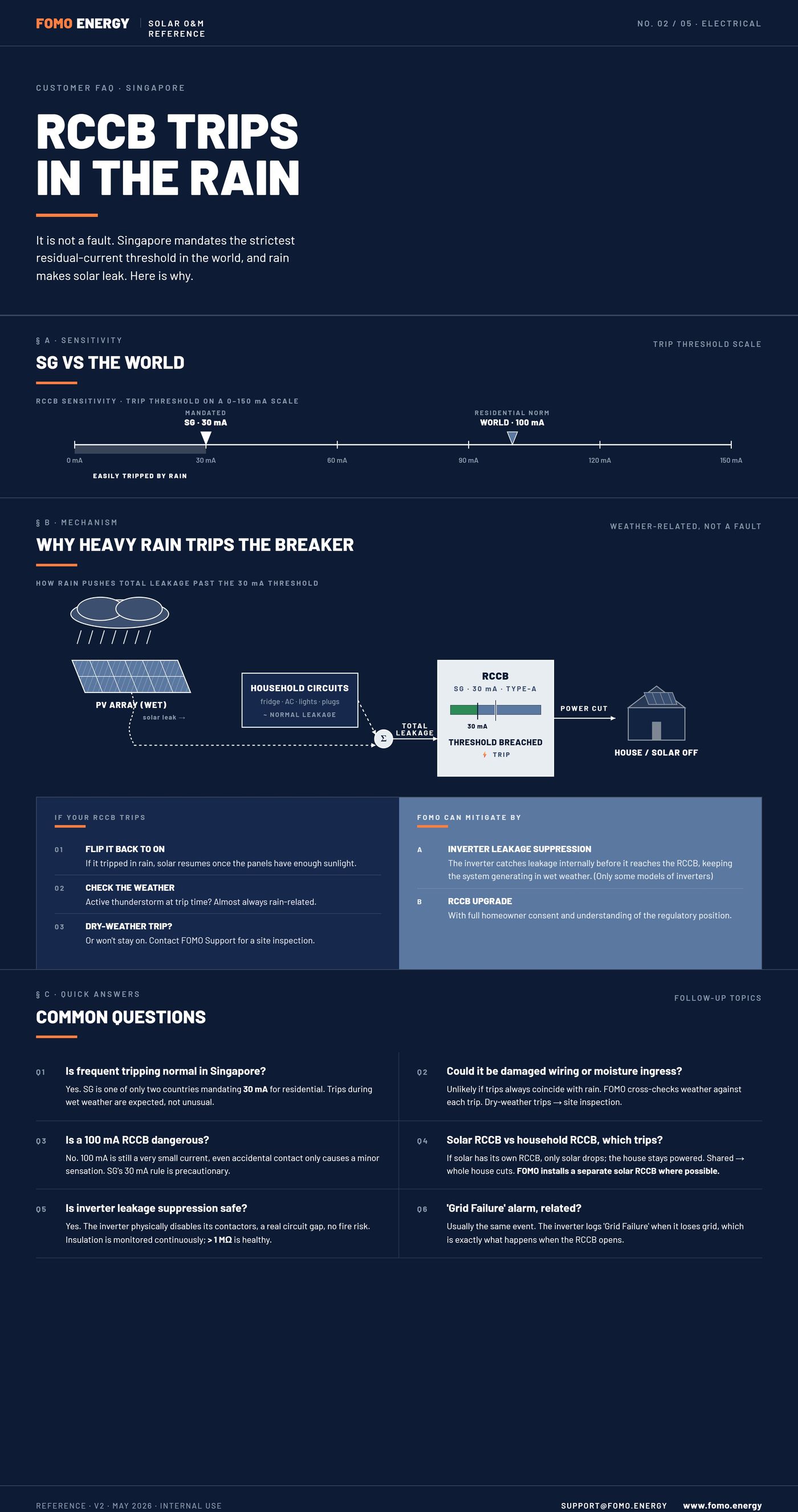
It is not a fault. Singapore mandates the strictest
residual-current threshold in the world, and rain makes solar leak. Here is why — and what to do
when it happens.
30 mA mandateWeather-relatedNot a faultWorld's strictest threshold30 mA mandateWeather-relatedNot a faultWorld's strictest threshold
30 mASingapore mandateThe residential trip threshold required by law here.
100 mAResidential norm elsewhereMore than three times less sensitive than Singapore.
Not a faultWhat a rain trip meansWet panels leak a little more. The breaker is doing its job.
§ A · SensitivityTrip threshold scale
The reason it feels sensitive
SG vs the World
Singapore is one of only two countries that mandate a 30 mA residual-current
threshold for homes. A breaker set that low reacts to leakage most other countries would simply
ignore.
MandatedSG · 30 mA
Residential normWorld · 100 mA
0 mA30 mA60 mA90 mA120 mA150 mA
Easily tripped by rain
§ B · MechanismWeather-related, not a fault
Move the slider
Why heavy rain trips the breaker
Every circuit leaks a tiny current to earth. Wet panels leak a little more.
Add the two together and a 30 mA breaker can be pushed over its limit. Drag from dry to heavy rain
and watch it happen.
Live leakage model
DryHeavy rain
Household circuitsfridge · AC · lights · plugs12.0 mA
PV array leakagerises as the panels get wet6.4 mA
Total leakage to earth18.4 mA
Below threshold · system running
Rain wets the PV arrayMoisture gives the array's normal leakage an easier
path to earth.
Dry
Household circuits keep leakingFridge, air-con, lights and plugs leak a
small amount all the time.
12.0 mA
The two add upThe RCCB does not care where leakage comes from. It measures
the total.
18.4 mA
30 mA breached → tripThe breaker opens and cuts power to whatever
sits behind it.
Holding
If your RCCB trips
Three things to check
Flip it back to on
If it tripped in rain, solar resumes once the panels have enough sunlight.
Check the weather
Active thunderstorm at trip time? It is almost always rain-related.
Dry-weather trip?
Or it will not stay on? Contact FOMO Support for a site inspection.
FOMO can mitigate by
Two options we offer
Inverter leakage suppression
The inverter catches leakage internally before it reaches the RCCB, keeping the system
generating in wet weather. Available on some inverter models only.
RCCB upgrade
Carried out with full homeowner consent and a clear understanding of the regulatory
position.
§ C · Quick answers
Common questions
Is frequent tripping normal in Singapore?
Yes. Singapore is one of only two countries mandating 30 mA for residential. Trips during wet
weather are expected, not unusual.
Could it be damaged wiring or moisture ingress?
Unlikely if trips always coincide with rain. FOMO cross-checks weather against each trip.
Dry-weather trips lead to a site inspection.
Is a 100 mA RCCB dangerous?
No. 100 mA is still a very small current — even accidental contact only causes a minor
sensation. Singapore's 30 mA rule is precautionary.
Solar RCCB or household RCCB — which one trips?
If solar has its own RCCB, only solar drops and the house stays powered. If it is shared, the
whole house cuts. FOMO installs a separate solar RCCB where possible.
Is inverter leakage suppression safe?
Yes. The inverter physically disables its contactors — a real circuit gap, no fire risk.
Insulation is monitored continuously; above 1 MΩ is healthy.
Is the 'Grid Failure' alarm related?
Usually the same event. The inverter logs 'Grid Failure' when it loses grid, which is exactly what
happens when the RCCB opens.
Download
The one-page reference
sheet
Everything on this page, condensed into a single sheet you can save or forward. Prepared by the
FOMO Energy Solar O&M team.