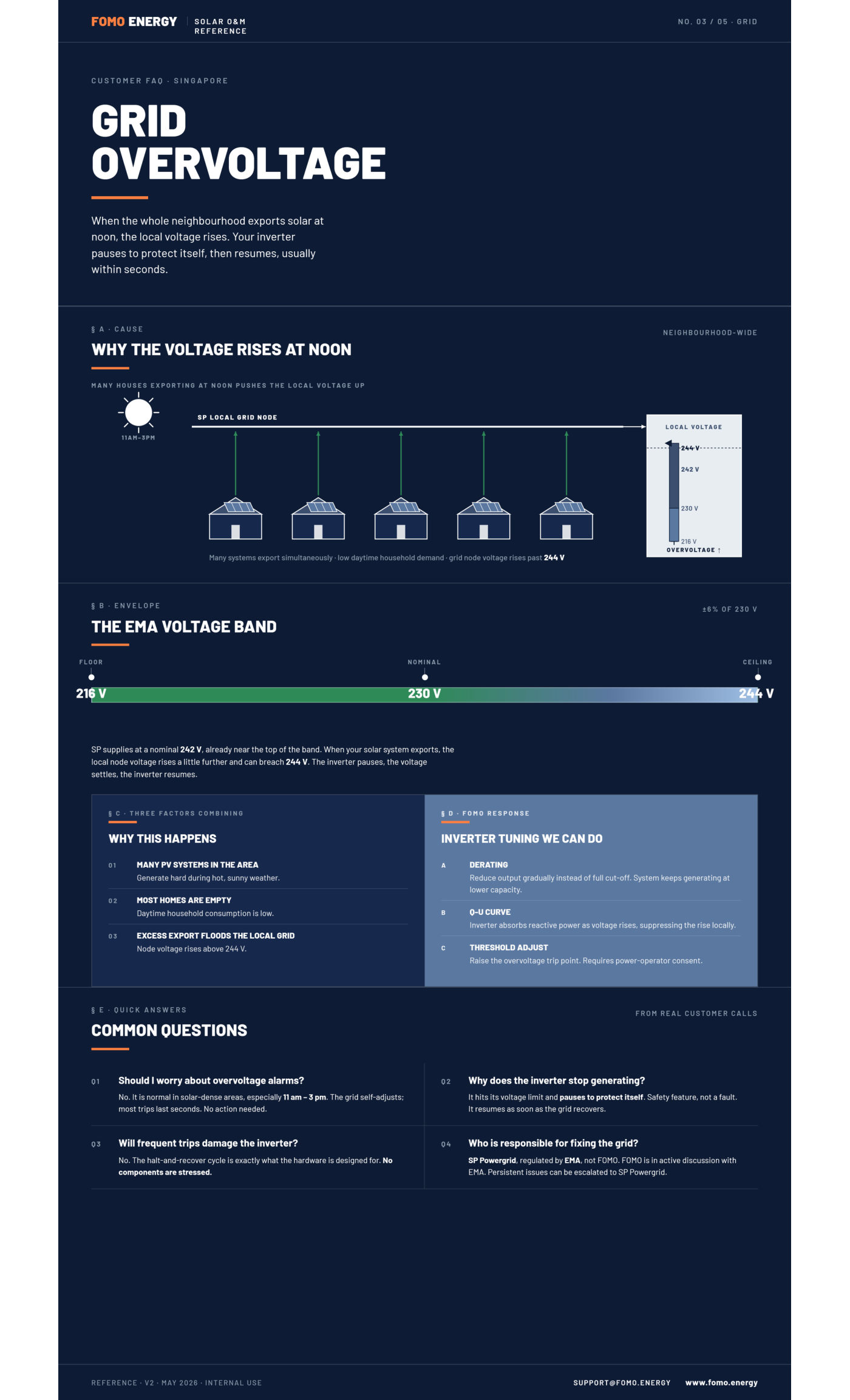
When the whole neighbourhood exports solar at noon, the local
voltage rises. Your inverter pauses to protect itself, then resumes — usually within seconds.
±6% of 230 VNeighbourhood-wideIt pauses, not breaksBack in seconds±6% of 230 VNeighbourhood-wideIt pauses, not breaksBack in seconds
244 VEMA ceilingThe top of the allowed band. Above this, the inverter steps back.
242 VWhat SP already suppliesNominal supply sits close to the ceiling before your solar adds anything.
SecondsTypical pauseThe grid self-adjusts and the inverter resumes on its own. No action needed.
§ A · CauseNeighbourhood-wide
Move the slider
Why the voltage rises at noon
Between 11am and 3pm most homes are empty, so hardly anyone is using power
— yet every rooftop is exporting at once. All that electricity pushes back into the same local
grid node, and the voltage there climbs. Drag to add more exporting neighbours.
Local grid node
Few exportingWhole street
242.6 V
Voltage at your grid node
Within band · exporting normally
Midday sun, empty housesPeak generation lands exactly when household
demand is at its lowest.
11am–3pm
Everyone exports at onceMany systems push power back into the same local
node together.
2 of 8 homes
Node voltage climbsSP already supplies near 242 V. The extra export
pushes it higher still.
242.6 V
244 V breached → inverter pausesIt protects itself, waits for the
voltage to settle, then resumes.
Generating
§ B · Envelope±6% of 230 V
The allowed range
The EMA voltage band
Floor216 V
Nominal230 V
Ceiling244 V
216 V223 V230 V237 V244 V
The white marker follows the slider above
SP supplies at a nominal 242 V, already near the top of the band. When your solar system
exports, the local node voltage rises a little further and can breach 244 V. The inverter pauses, the voltage settles, the inverter
resumes.
§ C · Three factors combining
Why this happens
Many PV systems in the area
They all generate hard during the same hot, sunny hours.
Most homes are empty
Daytime household consumption is low, so little of it is used on site.
Excess export floods the local grid
Node voltage rises above 244 V and the inverter steps back.
§ D · FOMO response
Inverter tuning we can do
Derating
Reduce output gradually instead of cutting off completely, so the system keeps generating
at lower capacity.
Q-U curve
The inverter absorbs reactive power as voltage rises, suppressing the rise locally.
Threshold adjust
Raise the overvoltage trip point. Requires power-operator consent.
§ E · Quick answers
Common questions
Should I worry about overvoltage alarms?
No. It is normal in solar-dense areas, especially between 11am and 3pm. The grid self-adjusts and
most trips last seconds. No action needed.
Why does the inverter stop generating?
It hits its voltage limit and pauses to protect itself. That is a safety feature, not a fault. It
resumes as soon as the grid recovers.
Will frequent trips damage the inverter?
No. The halt-and-recover cycle is exactly what the hardware is designed for. No components are
stressed.
Who is responsible for fixing the grid?
SP Powergrid, regulated by EMA — not FOMO. We are in active discussion with EMA, and
persistent issues can be escalated to SP Powergrid.
Download
The one-page reference
sheet
Everything on this page, condensed into a single sheet you can save or forward. Prepared by the
FOMO Energy Solar O&M team.