Solar PPA vs Upfront Solar: Which Financing Model Is Better in Singapore?
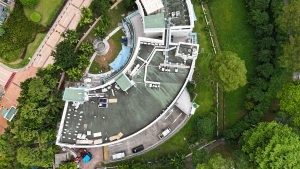
For commercial building owners, factories, warehouses and industrial facilities in Singapore, installing rooftop solar is no longer a question of if — but how.
The key decision most businesses face is this: Should you adopt a Solar Power Purchase Agreement (PPA), or invest in an Upfront Solar (CAPEX) system?
This in-depth 2026 guide explains the differences clearly — covering upfront costs, cashflow impact, accounting treatment, ownership structure, long-term return on investment, operational responsibility and contract flexibility.
Get a Side-by-Side Financial Comparison
Understanding Solar Financing Options in Singapore
In Singapore’s commercial market, rooftop solar systems are typically structured under two primary financing models:
- Solar PPA (Power Purchase Agreement): A third-party investor finances, installs and owns the solar system on your roof. Your company purchases the electricity generated at a contracted rate.
- Upfront Solar (CAPEX): Your company purchases and owns the solar system outright, funding installation and retaining full control over the asset.
Both models reduce reliance on grid electricity supplied by SP Group, but they differ significantly in financial structure and risk allocation.
Quick Comparison: Solar PPA vs Upfront Solar
| Factor |
Solar PPA |
Upfront Solar |
| Initial Investment |
$0 upfront |
Significant capital outlay |
| Ownership |
Developer owns system |
Company owns system |
| Accounting Treatment |
Operating expense (OPEX) |
Capital asset (CAPEX) |
| Maintenance |
Handled by provider |
Owner responsibility |
| Lifetime ROI |
Lower but stable |
Higher over 20–25 years |
Detailed ROI Comparison (Singapore Commercial Example)
Below is a simplified financial model comparing Solar PPA and Upfront Solar for a 500 kWp commercial rooftop system in Singapore.
- System Size: 500 kWp
- Annual Generation: ~650,000 kWh
- Grid Tariff Reference: $0.25 per kWh
- System Lifespan: 25 years
| Financial Metric |
Solar PPA |
Upfront Solar (CAPEX) |
| Upfront Cost |
$0 |
~$600,000 |
| Electricity Rate Paid |
~$0.21/kWh (PPA rate) |
$0 (self-generated) |
| Estimated Annual Savings |
~$26,000 |
~$162,500 |
| Simple Payback Period |
Not applicable |
~4 years |
| 25-Year Cumulative Savings |
~$650,000 |
~$3.4 million* |
*Before accounting for operations & maintenance costs and inverter replacement.
Key Insight: Solar PPA optimises short-term cashflow by eliminating upfront investment, while Upfront Solar ownership typically delivers significantly higher long-term financial returns over a 20–25 year horizon.
1. Upfront Costs and Capital Allocation
Under a Solar PPA, there is no upfront capital expenditure. The developer funds equipment, installation, regulatory approvals and commissioning. Your company begins saving from day one by purchasing electricity at a discounted rate.
With an Upfront Solar system, your business invests capital at the start. For medium-to-large commercial rooftops in Singapore, this often means a six-figure investment. However, you immediately own an energy-producing asset with a lifespan of 20–25 years.
Strategic consideration: Companies prioritising liquidity or expansion may prefer a PPA. Businesses with surplus capital seeking long-term yield often lean toward ownership.
2. Cashflow Impact and Financial Reporting
Solar PPA payments are typically treated as operating expenses. This can preserve debt capacity and simplify approval processes for CFOs and finance teams.
Upfront Solar installations are recorded as fixed assets and depreciated over time. Businesses may qualify for capital allowance treatment under IRAS guidelines, enhancing effective returns.
From a purely financial perspective, ownership generally delivers higher cumulative savings over the system lifespan, while PPAs provide smoother short-term cashflow management.
3. Ownership and Long-Term Value
Ownership fundamentally changes the economics of a solar project.
In a PPA structure, your company benefits from lower electricity rates but does not own the asset. At the end of the agreement, options may include renewal, buyout or system removal.
With Upfront Solar, the system becomes part of your building’s infrastructure. This can increase property value, improve ESG positioning and provide direct control over performance optimisation.
4. Operations, Maintenance and Performance Risk
Solar PPAs are typically fully managed. The provider handles monitoring, servicing, inverter replacements and performance guarantees.
Under ownership, your company assumes performance risk but retains upside potential. Many businesses mitigate operational burden by engaging professional O&M service providers.
5. Contract Tenure and Exit Flexibility
PPAs commonly run between 10 and 20 years. Early termination clauses and transfer provisions must be carefully reviewed, especially for tenants with shorter lease durations.
Upfront Solar offers maximum strategic flexibility. There is no electricity purchase contract tied to the system, and the asset can transfer with property ownership.
When Solar PPA Is a Better Fit
- Limited capital budget
- Focus on cashflow preservation
- Preference for outsourced maintenance
- Shorter investment horizon
When Upfront Solar Is a Better Fit
- Long property ownership horizon
- Access to affordable capital
- Desire for maximum lifetime savings
- Strong ESG and asset ownership strategy
Final Thoughts
Choosing between Solar PPA and Upfront Solar in Singapore ultimately depends on your capital structure, risk tolerance and long-term strategic objectives.
There is no universally superior model — only the structure that aligns best with your financial and operational priorities.
Frequently Asked Questions
Which option delivers higher long-term savings?
Ownership through Upfront Solar typically delivers higher total savings over 20–25 years, assuming stable electricity tariffs.
Is Solar PPA considered off-balance sheet?
Many PPAs are treated as operating expenses, but accounting treatment should be confirmed with your finance team.
Can I switch from PPA to ownership later?
Some PPAs include buyout clauses that allow system purchase after a defined period.
Related Reading: Commercial Solar PPA in Singapore: Complete Guide (2026)
