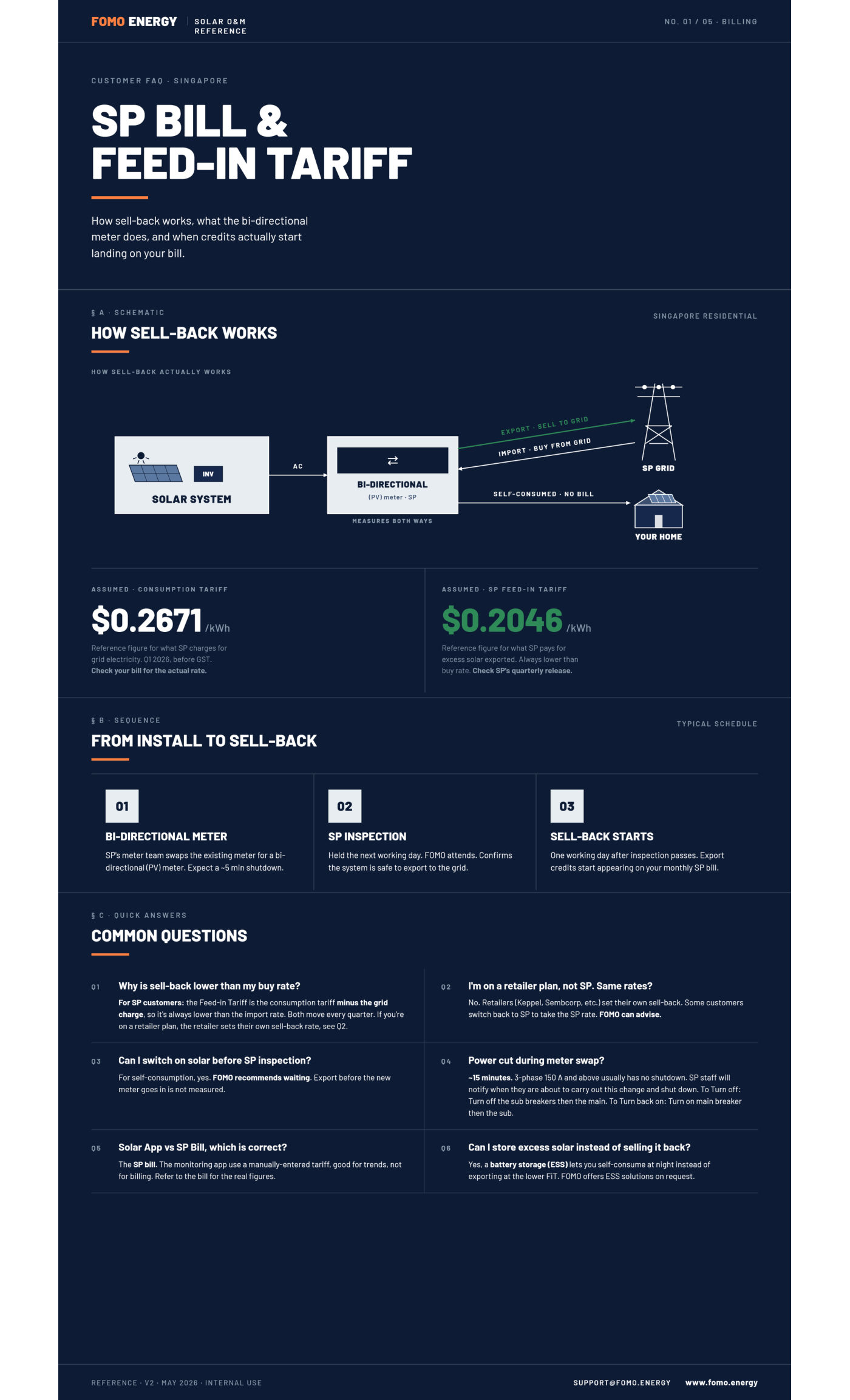
Bi-directional meterSelf-consume firstExport earns lessCredits on your SP billBi-directional meterSelf-consume firstExport earns lessCredits on your SP bill
$0.2671What you pay SP · per kWhReference consumption tariff, Q1 2026, before GST. Check your bill for the actual rate.
$0.2046What SP pays you · per kWhFeed-in tariff for excess solar exported. Always lower than the buy rate.
1 dayInspection to sell-backCredits start appearing one working day after the SP inspection passes.
§ A · SchematicSingapore residential
Move the sliders
Why self-consuming beats exporting
Every kWh you use yourself saves you the full buy rate. Every kWh you export
earns you the lower feed-in rate. So the more solar you use while it is being generated, the more
the system is worth to you.
Your month
Solar generated450 kWh
Used at home40%
180 kWh self-used270 kWh exported
Bill you avoid$48.08
Export credit$55.24
Total value this month$103.32
Solar system generatesDC from the panels, converted to AC by the
inverter.
450 kWh
Bi-directional meterSP's meter measures both ways — what you draw
in, and what you push out.
Both ways
Used at home firstSelf-consumed power is never billed. This is the most
valuable kWh you produce.
180 kWh
The rest goes to the gridExported at the lower feed-in rate and credited
on your SP bill.
270 kWh
Assumed · consumption tariff$0.2671/kWh
Reference figure for what SP charges for grid electricity. Q1 2026, before GST. Check your
bill for the actual rate.
Assumed · SP feed-in tariff$0.2046/kWh
Reference figure for what SP pays for excess solar exported. Always lower than the buy rate.
Check SP's quarterly release.
§ B · SequenceTypical schedule
What happens when
From install to sell-back
01 · Bi-directional meter
SP's meter team swaps the existing meter for a bi-directional (PV) meter.
Expect a shutdown of around 5 minutes.
02 · SP inspection
Held the next working day. FOMO attends. Confirms the system is safe to
export to the grid.
03 · Sell-back starts
One working day after the inspection passes. Export credits start appearing
on your monthly SP bill.
§ C · Quick answers
Common questions
Why is sell-back lower than my buy rate?
For SP customers, the feed-in tariff is the consumption tariff minus the grid
charge, so it is always lower than the import rate. Both move every quarter. On a
retailer plan, the retailer sets their own sell-back rate.
I'm on a retailer plan, not SP. Same rates?
No. Retailers such as Keppel or Sembcorp set their own sell-back rate. Some customers switch back
to SP to take the SP rate. FOMO can advise.
Can I switch on solar before the SP inspection?
For self-consumption, yes — but FOMO recommends waiting. Any export before the new meter
goes in is not measured, so you are not paid for it.
Will there be a power cut during the meter swap?
Around 15 minutes. Three-phase 150 A and above usually has no shutdown. SP staff notify you
before switching off. To turn off: sub breakers first, then the main. To turn back on: main
breaker first, then the subs.
Solar app or SP bill — which one is correct?
The SP bill. The monitoring app uses a manually entered tariff, which is good for spotting trends
but not for billing. Refer to the bill for the real figures.
Can I store excess solar instead of selling it back?
Yes. Battery storage (ESS) lets you self-consume at night instead of exporting at the lower
feed-in rate. FOMO offers ESS solutions on request.
Download
The one-page reference
sheet
Everything on this page, condensed into a single sheet you can save or forward. Prepared by the
FOMO Energy Solar O&M team.