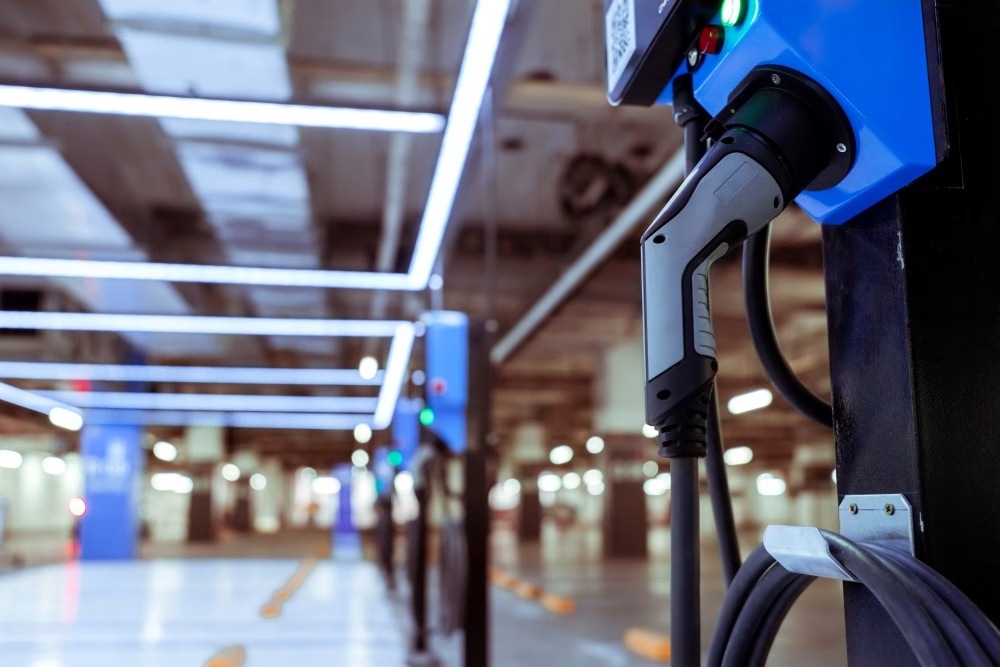
EV ownership in Singapore involves one decision most buyers don’t think about until the car is already in the driveway. The charging setup.
Some owners plug in at home and barely think about charging again. Others end up comparing four different apps at a mall carpark, hoping the 50kW unit is free. Same car, same commute, wildly different monthly bills. But which one is cheaper?
Where you live, how far you drive, and how much patience you have for public-charger roulette pretty much sets the direction. Here’s how the two options actually compare in Singapore.
How Does EV Charging Work?
Charging an EV isn’t the same as pulling into a petrol station and walking away in a couple of minutes. It runs on the current type (AC or DC) and power rating (kW), and those two variables decide how long you sit there and how much you pay.
AC Charging
AC (alternating current) is the same kind of power already running through your home sockets. When you plug in using AC, the car’s onboard charger converts it to DC before sending it to the battery. Per LTA’s EV driver guide, AC chargers in Singapore come in 7.4kW, 11kW, 22kW, and up to 43kW for 3-phase setups.
You’ll find AC at home wallboxes, condo carparks, offices, and malls. Basically anywhere your car sits long enough for a proper session, like an overnight charge or the two hours it takes to do groceries and lose track of time at the supermarket. Slower, cheaper per kWh, and easier on the battery over the long haul.
DC Fast Charging
DC (direct current) charging skips the car’s onboard converter and pushes power straight to the battery. The charger itself does the AC-to-DC conversion, which is why it’s faster and why the hardware costs more to run. Public DC fast chargers in Singapore start at 50kW and go all the way up to the 480kW monsters now at Great World and Pasir Ris Mall.
A 180kW unit can take a compatible EV from 0 to 80% in about 30 minutes. A 50kW unit takes closer to an hour for the same job.
Great for long drives, a dinner-time top-up on the way home, or the mornings when “I’ll plug in before bed” mysteriously didn’t happen.
Charging at Home: Benefits and Drawbacks
Home charging is undoubtedly hassle-free. You plug in when you arrive, go about your evening, and the car is ready by the time you’ve finished your kopi the next morning. No queues, no app logins, no surprise rate on a Sunday night.
Advantages of Home Charging
The short version: it’s the cheapest and most convenient way to keep an EV topped up.
- Lower cost per kWh: Singapore residential tariffs sit around S$0.30 per kWh, which works out to roughly S$15 for a full charge on a 60kWh battery (depending on usage, tariff plan, and battery size).
- No queues, no app drama: The charger is always available, always working, and doesn’t want a three-step login at 11pm.
- Overnight charging: Plug in once, wake up to a full battery, skip the range anxiety before a 7am meeting.
- Easier on the battery: AC charging produces less heat than DC fast, which means less thermal stress over the years.
- Full control: You pick the timing, and if you’re on a time-of-use plan, overnight sessions sync up with the cheapest hours of the day.
Drawbacks of Home Charging
The short version: the upfront isn’t zero, and it’s slower than public DC.
- Install cost: Home EV charger installation in Singapore typically runs S$3,500 to S$8,000, covering the charger, a Licensed Electrical Worker (LEW), and any electrical upgrades the supply needs.
- Slower than DC fast: A 7.4kW or 11kW wallbox won’t match a 180kW DC unit. For a rapid recovery before a road trip, the home charger is the wrong OPTION.
- Private parking only: You’ll need a landed driveway or a dedicated condo lot. HDB residents and landed owners without sheltered parking will have fewer options.
- Older homes may need an upgrade: Some houses with tight electrical headroom need a panel upgrade before the wallbox can go in, which adds to the bill.
Best for: landed homeowners with dedicated parking, daily commuters, and anyone with a predictable enough routine to charge overnight.
Public Charging: Benefits and Drawbacks
Singapore’s public charging network has grown fast. Over 1,600 HDB carparks now have chargers, and malls, offices, and petrol stations have kept pace. The whole premise is that idle time (shopping, working, dinner) becomes charging time. A cool theory, until the charger you planned to use is already occupied by someone treating it as a regular parking spot.
Advantages of Public Charging
The short version: fast when you need it, and available where home charging isn’t.
- Speed: DC fast chargers can deliver a 20% to 80% top-up in roughly 20 to 60 minutes, depending on output and what the car accepts.
- Zero upfront: No hardware to buy, no installer to schedule, no panel upgrade to plan around.
- Wide coverage: Malls, offices, petrol stations, HDB carparks, all rolling out more units every year.
- Idle-time charging: Shopping trips, work days, and long dinners become charging sessions without you doing anything extra.
- Essential for HDB residents: For anyone without a dedicated home parking lot, the public network is the entire setup.
Drawbacks of Public Charging
The short version: pricier, less predictable, and occasionally annoying in ways the sticker rate doesn’t capture.
- Higher rates: Public AC sits at aboutS$0.40 to S$0.65 per kWh. DC fast can go over S$0.90 per kWh. A full charge at public rates can run two to three times what the same session costs at home.
- Queues and availability: Peak hours and popular hubs fill up, and a broken unit at the mall means driving to the next one.
- Idle fees: Some operators charge extra if your car stays plugged in after the session ends, which turns a forgotten reminder into real money.
- Connector variation: Most public units are Type 2 (AC) and CCS2 (DC), but the occasional CHAdeMO-only unit still exists. Know your plug beforehand.
- Battery stress over time: Frequent DC fast charging produces more heat than the battery wants as a daily routine.
Best for: HDB residents without home charging, emergency top-ups, and longer drives where speed beats rate.
Home vs Public Charging: A Side-by-Side Comparison
Dimension | Home Charging | Public AC | Public DC Fast |
Rate per kWh | ~S$0.30 | S$0.58 to S$0.74 | S$0.73 to S$0.83 |
Full charge (60kWh EV) | ~S$15 | S$35 to S$44 | S$0.73 to S$0.83 |
Charging speed | 7.4kW to 22kW AC | 7.4kW to 43kW AC | 50kW to 480kW DC |
Convenience | Plug-and-forget | Depends on availability | Quick top-up |
Upfront cost | S$3,500 to S$8,000 install | None | None |
Battery health | Less thermal stress | Less thermal stress | Higher thermal stress |
Best for | Daily charging | Workday and mall top-ups | Emergencies, road trips |
What Singapore EV Drivers Should Consider