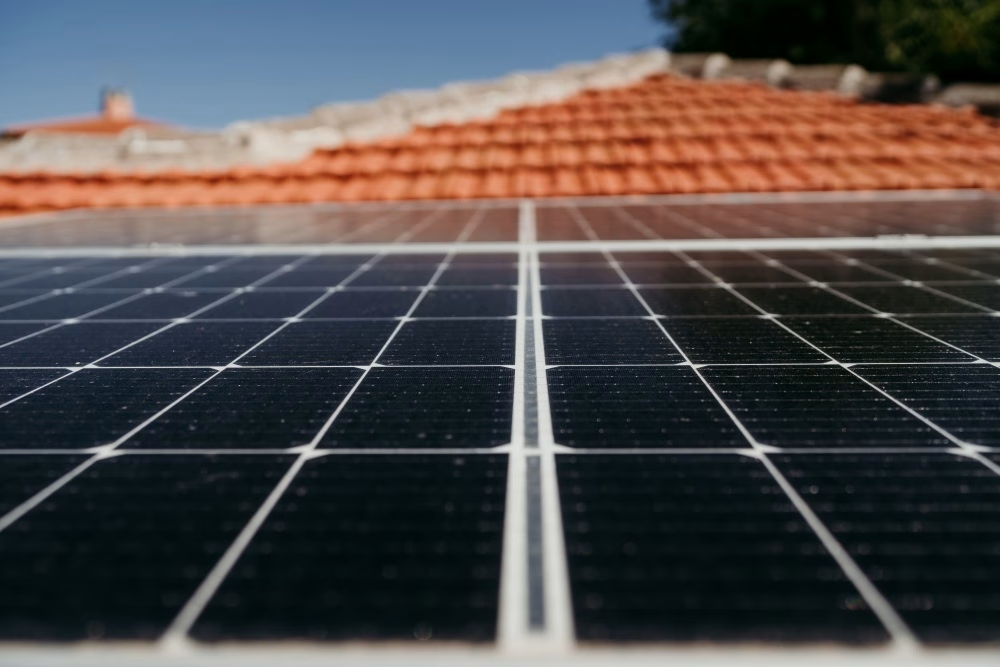
Most landed homeowners in Singapore look up at their roof, give it a quick nod, and assume it’ll be able to handle a couple of solar panels up top. For most, it does. For the unlucky few, the problem shows up later, in an SP bill that never drops the way the quote said it would.
Most private residential roofs in Singapore are solar-ready, some need a bit of work to get there, and a handful simply don’t qualify. The checklist below is how installers tell which is which, before a single panel goes up.
6 Factors That Determine Whether Your Roof is Solar-Ready
Every solar-ready roof clears all six. Fail one badly and the rest stop mattering as much.
1. Roof Condition and Age
A solar panel system is a 25 to 30-year commitment. So, naturally, your roof needs to be willing to sign up for the same term. If it’s already counting down to retirement, that’s the problem to sort first, because taking panels off and reinstalling them after a reroofing job is a cost better sequencing would have avoided. And nobody enjoys paying twice for scaffolding. Therefore, for homeowners already planning a new roof, putting solar panels on as part of the same project is usually the most logical path.
The signs worth checking are the usual ones. Cracked or slipping tiles, visible sagging along the ridgeline, water stains on the ceiling below, or tiles that have gone brittle and powdery. None of these rules solar out on their own. They just need sorting before anything goes up.
2. Roof Orientation and Tilt
Type “best solar panel orientation” into Google, and you’ll probably get answers like facing south or tilting at 35 to 90 degrees. Great advice, if you live in Surrey.
Singapore sits at 1.3 degrees north, close enough to the equator that the sun takes an almost completely different route across our sky. This means that the south-facing advice simply does not travel well to the tropics.
Orientation matters far less here than in temperate climates. If anything, research on Singapore’s specific conditions has found east-facing panels actually generate marginally more energy. However, the same study demonstrated that the differences between the south, east, and west are small. As such, no orientation rules solar out on its own, plus, most landed homes have more than one roof plane to work with anyway.
Tilt tells the same story. Optimal here is shallow. Most installers, and as advised by the Urban Development Authority (URA), aim for between 10 and 15 degrees, which is steep enough for rain to wash dust off the panels and close to the mathematical optimum at this latitude.
3. Shading From Surrounding Structures
Shade does more damage to a solar panel system than anything else on this list. Even partial shading on one panel can drag the output of an entire string down with it if the system wasn’t designed to handle it. The fix exists. Module-level electronics like microinverters or power optimisers let each panel work on its own, so one shaded corner stops being everybody’s problem.
The trap is that shade moves. Something that looks harmless at noon might still shade a quarter of your panels between 8am and 10am, when they should be getting into the swing of the day. A proper assessment checks the roof at different times of day, not only when the surveyor happens to show up. The usual suspects on landed homes are mature trees, neighbouring properties, water tanks, and rooftop add-ons that went up years after the house was built.
4. Available Roof Space
Usable roof space and total roof area are two different numbers, and only one of them matters. It’s the same logic behind a condo floor plan, where the strata area on the brochure and the part you actually live in are rarely the same figure, and the gap is never in your favour. Skylights, vents, air-conditioning condensers, dormer windows, and mandatory setbacks for firefighter access all eat into what’s actually available on the roof.
A modern residential panel like the AIKO modules we install at FOMO Energy takes up a meaningful chunk of the roof once modern panels, spacing, and setbacks are factored in
If the main roof doesn’t have the room, secondary structures usually take up the slack. Car porches and flat extensions are fair game, and in many landed designs, they actually catch more sun than the main roof.
5. Structural Integrity and Load Capacity
A typical residential solar array adds about 15 to 20 kilograms per square metre once panels, mounting rails, and the rest of the hardware are factored in. Most landed homes in Singapore, whether terrace, semi-detached, or bungalow, are built with plenty of structural margin for this. Monsoon-proof is a higher bar than solar-proof, and the monsoon was designed long before anything went on top.
Older properties and homes with lightweight roof structures sometimes need a closer look. That’s not a call the homeowner has to make alone. Every solar rooftop installation in Singapore has to be signed off by a Professional Engineer under BCA and SCDF regulations, and any reinforcement needed gets flagged and handled before the system goes up.
6. Roof Material Compatibility
Metal roofing is the easiest case, especially standing seam profiles, where panels clamp on without any drilling, and the waterproofing stays completely intact. Concrete tiles are the most common roof type on landed homes in Singapore and mount cleanly with tile hooks. Clay tiles work the same way, with a slower and more careful installation to avoid cracking anything you can’t cheaply replace.
A few surfaces need special handling, or are outright non-starters. Asbestos roofing, for one, has to be removed by a licensed specialist before any solar work begins, and there’s no shortcut around it. Glass roofs and conservatories aren’t structurally suitable for standard systems. Thatch and wood shingles are rare in Singapore, and most installers won’t work with them for reasons that mostly come down to fire.
Can You Put Solar Panels on Any Roof?