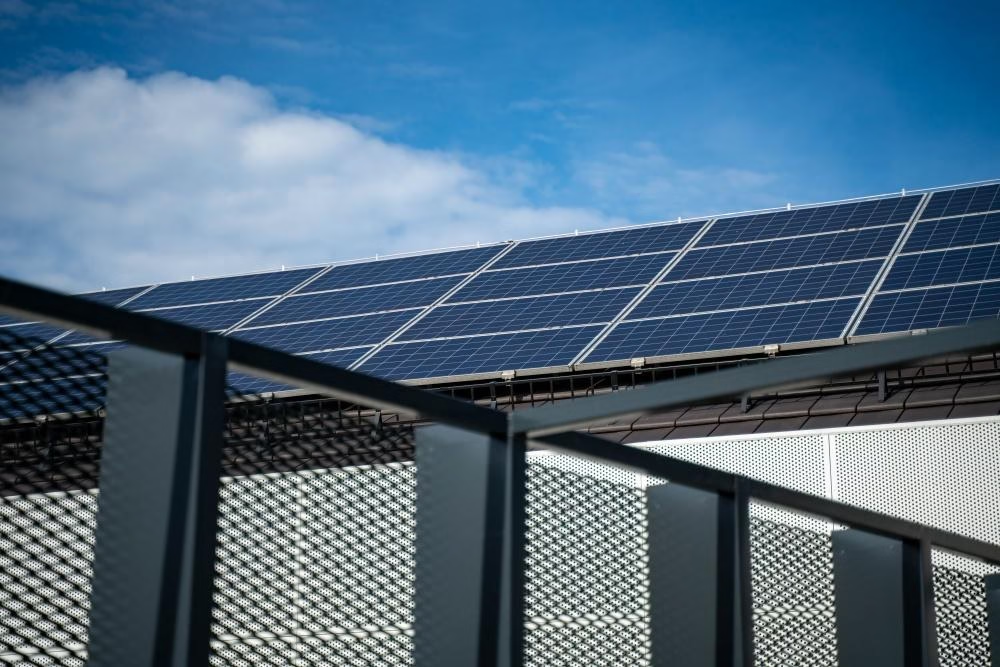
Not owning the roof does not leave HDB residents without solar energy. The benefit comes through two existing channels.
1. The SolarNova Programme
SolarNova is a whole-of-government programme led by HDB and the Economic Development Board (EDB) that pools public-sector demand for solar energy. There are over 10,000 HDB blocks, and the programme has already committed more than 80% of its 540 MWp target for 2030, with panels installed on thousands of blocks and more added in batches. For a resident, it works like this:
- Common-area power: HDB solar panels sit on the communal roof and run shared services such as lifts, corridor lights, and water pumps, with any excess fed back to the national grid.
- Lower estate costs: The solar offsets what the Town Council pays for electricity, and those savings can flow through to your Service and Conservancy Charges.
- Simple to check: Your Town Council can confirm whether your block is already covered.
2. Green Electricity Plans Through the Open Electricity Market
A green electricity plan through a licensed Open Electricity Market retailer is the other route, and it requires nothing on the roof:
- How it works: The plan matches your household consumption with Renewable Energy Certificates (RECs), backing your usage with renewable energy without anything being installed.
- What it involves: No installation, no approval, no modification to the flat.
- Who it suits: A flat owner who wants to support Singapore’s clean energy transition with the least friction.
Are Newer HDB BTO Flats Designed with Solar in Mind?
New BTO developments are in a different category. Since 2020, HDB has built new projects solar-ready, which speeds up SolarNova deployment once a block is due. The solar-ready features include:
- Pre-installed rooftop mounting rails and anchor points
- Dedicated electrical conduits running from the roof to the electrical rooms
- Advanced Metering Infrastructure (AMI) smart meters
New developments are also built to at least BCA Green Mark GoldPLUS, which carries on-site renewable generation targets. For anyone collecting keys to a new BTO, the block roof is very likely already scheduled for panels.
The Bottom Line for Landed Homeowners
From the above, it is clear that HDB residents are not left out of the benefits of solar energy. However, the access is indirect: through SolarNova on the common areas and green retail plans on the meter.
Direct generation with full bill savings is a different matter. Putting solar panels on your own home today requires landed ownership.
If you own a terrace, semi-detached, or bungalow, the roof is one of the most underused parts of the property. A properly sized system delivers on three fronts:
- Bill savings: Solar panels for your home can cut the electricity bill by up to 80%, depending on usage, system size, and tariff plan.
- Grid credits: Excess energy earns credits back through the SCT or ECIS scheme, offsetting what you draw from the grid overnight.
- Payback: Typical payback periods may range from six to nine years, depending on usage, tariffs, and system size, after which the system keeps generating for the rest of its working life.
FOMO Energy builds rooftop solar for landed homes in Singapore, with in-house teams handling design, installation, and after-care. Our Rent-to-Own solar model puts a home solar installation on the roof at S$0 upfront, subject to eligibility, and our REConnect programme covers monitoring and maintenance once the system is running.
For homeowners weighing the numbers, Rent-to-Own solar keeps your capital untouched while the electricity bill starts dropping from the first month. A quick assessment shows the solar panel system size that suits your roof, the savings from the first month, and the point at which the system becomes yours fully.
Book a free quote.